Three high-impact security vulnerabilities have been disclosed
in APC Smart-UPS devices[1]
that could be abused by remote adversaries as a physical weapon to
access and control them in an unauthorized manner.
Collectively dubbed TLStorm[2], the flaws “allow for
complete remote takeover of Smart-UPS devices and the ability to
carry out extreme cyber-physical attacks,” Ben Seri and Barak
Hadad, researchers from IoT security company Armis, said in a
report published Tuesday.
Uninterruptible power supply (UPS[3]) devices function as
emergency backup power providers in mission-critical environments
such as medical facilities, server rooms, and industrial systems.
Most of the afflicted devices, totaling over 20 million, have been
identified so far in healthcare, retail, industrial, and government
sectors.
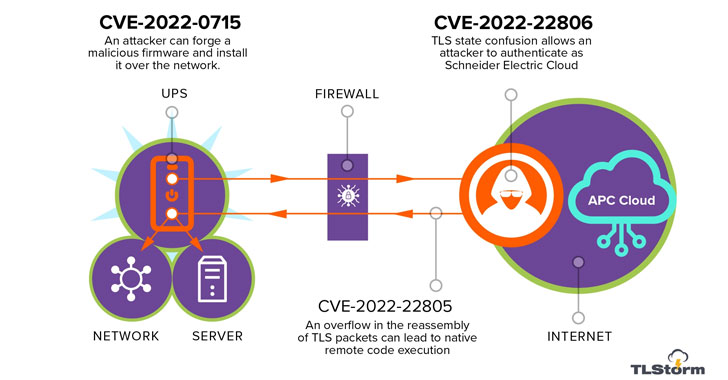
TLStorm consists of a trio of critical flaws that can be
triggered via unauthenticated network packets without requiring any
user interaction, meaning it’s a zero-click attack, with two of the
issues involving a case of faulty TLS handshake[4]
between the UPS and the APC cloud –
- CVE-2022-22805 (CVSS score: 9.0) – TLS buffer
overflow - CVE-2022-22806 (CVSS score: 9.0) – TLS
authentication bypass - CVE-2022-0715 (CVSS score: 8.9) – Unsigned
firmware upgrade that can be updated over the network
Successful exploitation of any of the flaws could result in
remote code execution (RCE) attacks on vulnerable devices, which in
turn could be weaponized to tamper with the operations of the UPS
to physically damage the device or other assets connected to
it.
“By using our RCE vulnerability we were able to bypass the
software protection and let the current spike periods run over and
over until the DC link capacitor heated up to ~150 degrees celsius
(~300F), which caused the capacitor to burst and brick the UPS in a
cloud of electrolyte gas, causing collateral damage to the device,”
the researchers explained[5].
To make matters worse, the flaw in the firmware upgrade
mechanism could be leveraged to plant a malicious update on UPS
devices, enabling the attackers to establish persistence for
extended periods of time and use the compromised host as a gateway
for further attacks.
“Abusing flaws in firmware upgrade mechanisms is becoming a
standard practice of APTs, as has been recently detailed in the
analysis of the Cyclops Blink malware[6], and improper signing of
firmwares of embedded devices is a recurring flaw in various
embedded systems,” the researchers said.
Following responsible disclosure to Schneider Electric on
October 31, 2021, fixes have been released as part of Patch Tuesday updates[7]
on March 8, 2022. Customers are recommended to install the updates
provided to reduce the risk of successful exploitation of these
vulnerabilities.
“UPS devices, like many other digital infrastructure appliances,
are often installed and forgotten,” the researchers concluded.
“Since these devices are connected to the same internal networks as
the core business systems, exploitation attempts can have severe
implications.”
References
- ^
APC
Smart-UPS devices (www.apc.com) - ^
TLStorm
(www.armis.com) - ^
UPS
(en.wikipedia.org) - ^
TLS
handshake (en.wikipedia.org) - ^
explained
(info.armis.com) - ^
Cyclops
Blink malware (thehackernews.com) - ^
Patch
Tuesday updates
(download.schneider-electric.com)
Read more https://thehackernews.com/2022/03/critical-bugs-could-let-attackers.html