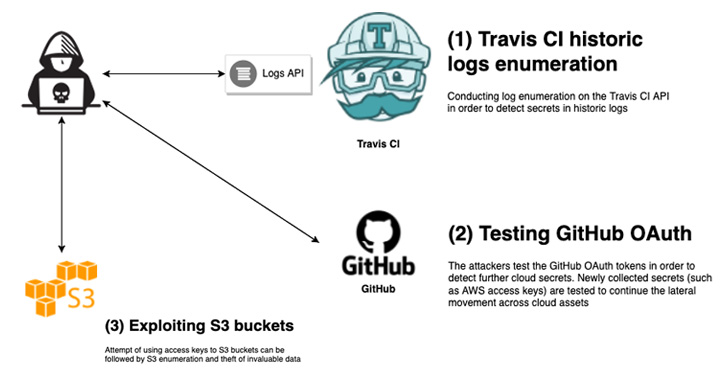
An unpatched security issue in the Travis CI API has left tens
of thousands of developers’ user tokens exposed to potential
attacks, effectively allowing threat actors to breach cloud
infrastructures, make unauthorized code changes, and initiate
supply chain attacks.
“More than 770 million logs of free tier users are available,
from which you can easily extract tokens, secrets, and other
credentials associated with popular cloud service providers such as
GitHub, AWS, and Docker Hub,” researchers from cloud security firm
Aqua said[1]
in a Monday report.
Travis CI is a continuous integration[2]
service used to build and test software projects hosted on cloud
repository platforms such as GitHub and Bitbucket.
The issue, previously reported in 2015 and 2019[3], is rooted in the fact
that the API[4]
permits access to historical logs in cleartext format, enabling a
malicious party to even “fetch the logs that were previously
unavailable via the API.”
The logs go all the way back to January 2013 and up until May
2022, ranging from log numbers 4,280,000 to 774,807,924, which are
used to retrieve a unique cleartext log through the API.
What’s more, further analysis of 20,000 logs revealed as many as
73,000 tokens, access keys, and other credentials associated with
various cloud services like GitHub, AWS, and Docker Hub.
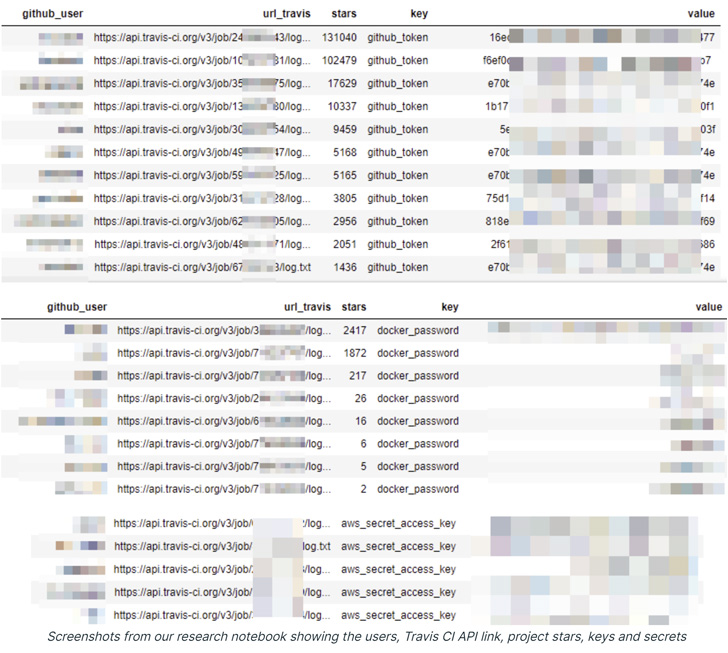
This is despite Travis CI’s attempts to rate-limit the API[5]
and automatically filter out[6] secure environment
variables and tokens from build logs by displaying the string
“[secure]” in their place.
One of the critical insights is that while “github_token” was
obfuscated, 20 other variations of this token that followed a
different naming convention — including github_secret, gh_token,
github_api_key, and github_secret — weren’t masked by Travis
CI.
“Travis CI slowed down the velocity of API calls, which hinders
the ability to query the API,” the researchers said. “In this case
however, this was not enough. A skilled threat actor can find a
workaround to bypass this.”
“However, combining the ease of accessing the logs via the API,
incomplete censoring, accessing ‘restricted’ logs, and a weak
process for rate limiting and blocking access to the API, coupled
with a large number of potentially exposed logs, results in a
critical situation.”
Travis CI, in response to the findings, has said the issue is
“by design,” necessitating that users follow best practices to
avoid leaking secrets in build logs and periodically rotate tokens
and secrets.
The findings are particularly significant in the wake of an
April 2022 attack campaign[7] that leveraged stolen
OAuth user tokens issued to Heroku and Travis CI to escalate access
to NPM infrastructure and clone select private repositories.
References
- ^
said
(blog.aquasec.com) - ^
continuous integration
(en.wikipedia.org) - ^
2019
(edoverflow.com) - ^
API
(developer.travis-ci.com) - ^
rate-limit the API
(www.cloudflare.com) - ^
automatically filter out
(docs.travis-ci.com) - ^
April
2022 attack campaign (thehackernews.com)
Read more https://thehackernews.com/2022/06/unpatched-travis-ci-api-bug-exposes.html