A China-based financially motivated group is leveraging the
trust associated with popular international brands to orchestrate a
large-scale phishing campaign dating back as far as 2019.
The threat actor, dubbed Fangxiao by Cyjax, is said to
have registered over 42,000 imposter domains[1], with initial activity
observed in 2017.
“It targets businesses in multiple verticals including retail,
banking, travel, and energy,” researchers Emily Dennison and Alana
Witten said[2]. “Promised financial or
physical incentives are used to trick victims into further
spreading the campaign via WhatsApp.”
Users clicking on a link sent through the messaging app are
directed to an actor-controlled site, which, in turn, sends them to
a landing domain impersonating a well-known brand, from where the
victims are once again taken to sites distributing fraudulent apps
and bogus rewards.
These sites prompt the visitors to complete a survey to claim
cash prizes, in exchange for which they are asked to forward the
message to five groups or 20 friends. The final redirect, however,
hinges on the IP address of the victim and the browser’s User-Agent string[3].
More than 400 organizations, including Emirates, Shopee,
Unilever, Indomie, Coca-Cola, McDonald’s, and Knorr, are being
imitated as part of the criminal scheme, the researchers said.
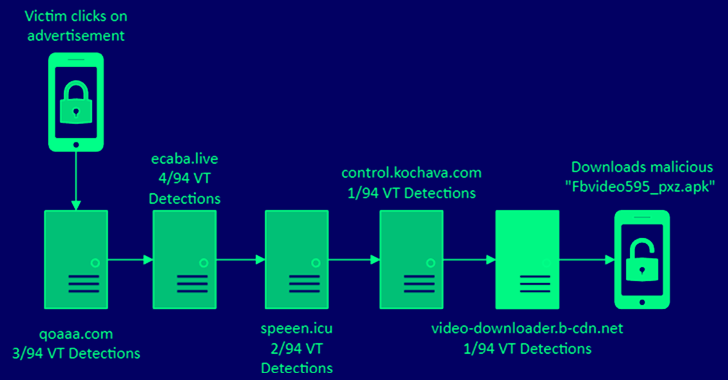
Alternatively, attacks wherein scammy mobile ads are clicked
from an Android device have been observed to culminate in the
deployment of a mobile trojan called Triada[4], which was recently
spotted propagating via fake WhatsApp apps.
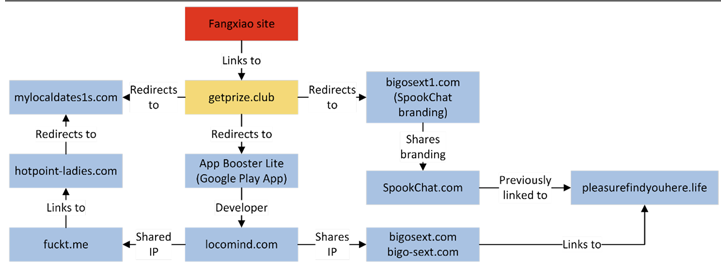
It’s not just Triada, as another destination of the campaign is
the Google Play Store listing of an app called “App Booster Lite –
RAM Booster” (com.app.booster.lite.phonecleaner.batterysaver.cleanmaster[5]), which has over 10
million downloads.
The app, made by a Czechia-based developer known as LocoMind, is
described as a “Powerful Phone Booster,” “Smart Junk Cleaner,” and
an “Effective Battery Saver.”
Reviews for the app have called out the publisher for showing
too many ads, and even point out that they “Arrived here [the Play
Store page] from one of those ‘your android is damaged x%’
ads.”
“Our app can’t spread viruses,” LocoMind responded to the review
on October 31, 2022. “Each of our updates is checked by Google Play
– they would have removed our app long ago for this reason.”
Should the same action be performed from a device running iOS,
the victim is redirected to Amazon via an affiliate link, netting
the actor a commission for every purchase on the e-commerce
platform made during the next 24 hours.
The threat actor’s China connections stem from the presence of
Mandarin text in a web service associated with aaPanel[6], a Python-based open
source control panel for hosting multiple websites.
Further analysis of the TLS certificates issued to the survey
domains in 2021 and 2022 reveals that a bulk of the registrations
overlap with the UTC+08:00 time zone, which corresponds to China
Standard Time from 9:00 a.m. to 11:00 p.m.
“The operators are experienced in running these kinds of
imposter campaigns, willing to be dynamic to achieve their
objectives, and technically and logistically capable of scaling to
expand their business,” the researchers said.
“The Fangxiao campaigns are effective lead generation methods
which have been redirected to various domains, from malware, to
referral links, to ads and adware.”
References
- ^
42,000
imposter domains (www.cyjax.com) - ^
said
(www.cyjax.com) - ^
User-Agent string
(developer.mozilla.org) - ^
Triada
(thehackernews.com) - ^
com.app.booster.lite.phonecleaner.batterysaver.cleanmaster
(play.google.com) - ^
aaPanel
(github.com)
Read more https://thehackernews.com/2022/11/chinese-hackers-using-42000-imposter.html