Feb 16, 2023Ravie Lakshmanan
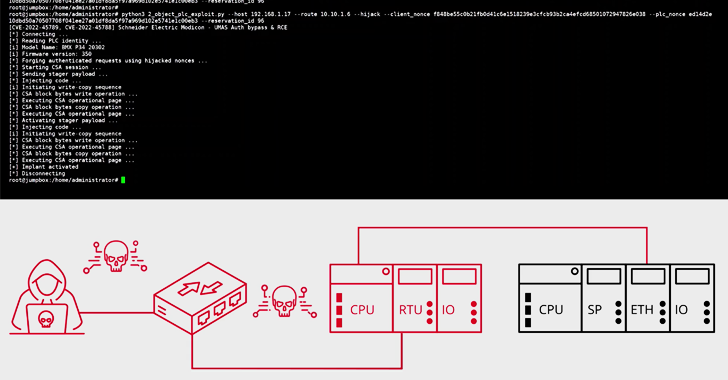
Security researchers have disclosed two new vulnerabilities
affecting Schneider Electric Modicon programmable logic controllers
(PLCs) that could allow for authentication bypass and remote code
execution.
The flaws, tracked as CVE-2022-45788[1]
(CVSS score: 7.5) and CVE-2022-45789[2]
(CVSS score: 8.1), are part of a broader collection[3]
of security defects[4]
tracked by Forescout as OT:ICEFALL.
Successful exploitation of the bugs could enable an adversary to
execute unauthorized code, denial-of-service, or disclosure of
sensitive information.
The cybersecurity company said the shortcomings can be chained
by a threat actor with known flaws from other vendors (e.g.,
CVE-2021-31886[5]) to achieve deep lateral
movement in operational technology (OT) networks.
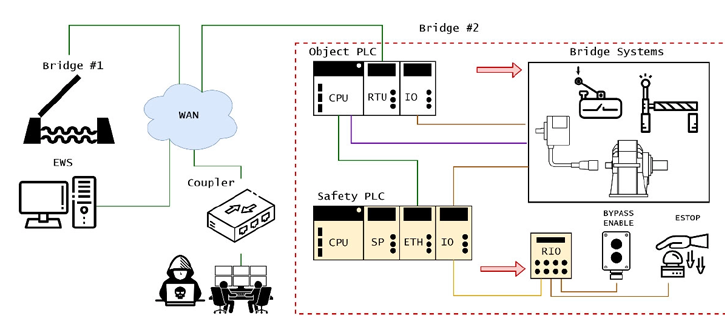
“Deep lateral movement lets attackers gain deep access to
industrial control systems and cross often overlooked security
perimeters, allowing them to perform highly granular and stealthy
manipulations as well as override functional and safety
limitations,” Forescout said[6].
A highly intricate proof-of-concept (PoC) cyber-physical attack
devised by the San Jose-based firm found that the flaws could be
weaponized to bypass safety guardrails and inflict damage upon a
movable bridge infrastructure.
With threat actors concocting sophisticated malware[7]
to disrupt industrial control systems, the deep lateral movement
afforded by these flaws could permit adversaries to use an
“uninteresting device as a staging point for moving towards more
interesting targets.”
The findings come close on the heels of 38 security flaws that
were revealed[8]
in wireless industrial internet of things (IIoT) devices and which
could grant an attacker a direct line of access to OT networks,
according to cybersecurity company Otorio.
Taken together, the weaknesses also underscore the real threats
to physical operations from IoT devices, cloud-based management
platforms, and nested OT networks.
Found this article interesting? Follow us on Twitter [9]
and LinkedIn[10] to read more exclusive
content we post.
References
- ^
CVE-2022-45788
(nvd.nist.gov) - ^
CVE-2022-45789
(nvd.nist.gov) - ^
broader
collection (thehackernews.com) - ^
security
defects (thehackernews.com) - ^
CVE-2021-31886
(thehackernews.com) - ^
said
(www.forescout.com) - ^
sophisticated malware
(thehackernews.com) - ^
revealed
(thehackernews.com) - ^
Twitter
(twitter.com) - ^
LinkedIn
(www.linkedin.com)
Read more https://thehackernews.com/2023/02/researchers-warn-of-critical-security.html